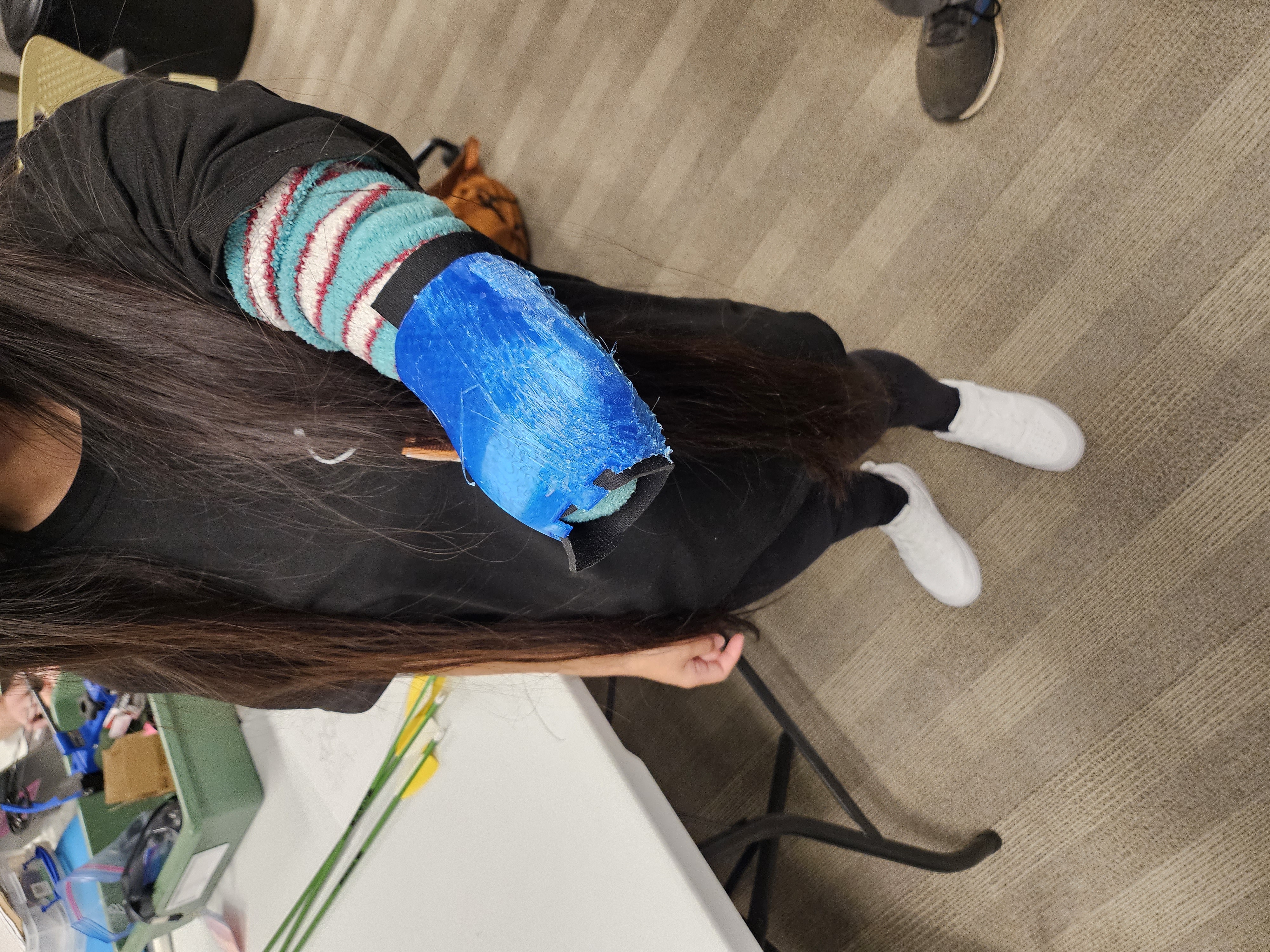
Two briefs. Two users. No renders — just builds.
Overview
Form 5 COFAB is a Columbus-based program that pairs industrial design students with industry professionals to solve a specific problem: people who use adaptive devices often can't access commercial solutions — they're too expensive, too generic, or simply don't exist for their use case. The program's answer is to design and build directly for real users, with accessible tools and collaborative expertise.
I participated twice, in separate cohorts. Each time was a distinct project: different person, different activity, different form requirements. What they shared was the same process — brief, sketch, prototype, fit, refine, deliver — and the same standard: it had to actually work for the person in front of you.
A — Hockey Grip Adaptor · Feb 2024
The user was a child with a limb difference who wanted to play hockey. Not adapt around it — play it. The brief was to design a grip adaptor that would let them hold and control a stick through the full range of skating, passing, and shooting.
Commercially available adaptive hockey equipment at this level is sparse, and almost nothing is sized for a child's body. The constraints that shaped every decision were durability under sport load, fit to the user's specific arm and hand geometry, and cost low enough that the family could replace or iterate the piece without a clinical referral.
The process was fast: sketch a grip geometry, cut a rough form, put it in the user's hand. Identify what failed — mechanically, ergonomically, in terms of where force transferred during a shot. Revise and repeat. Working with industry mentors meant the feedback was direct and immediate, not filtered through a studio critique.
B — Guitar Pick Adaptor · Oct 2024
The second project was a different person and a different physical problem. The user was a guitarist with a hand absence who wanted to strum and pick with control. Standard picks require a pinch grip that isn't available to them — the brief was to design an adaptor that securely holds a pick and allows consistent, comfortable strumming.
Where the hockey adaptor was designed around impact force and dynamic motion, this one was about retention and feel. The adaptor needed to hold the pick firmly enough not to shift mid-strum, while remaining comfortable across a full practice session and not muffling the tactile feedback that informs playing.
The form factor was entirely different from Project A — lighter loads, finer tolerances, more attention to how the piece sat against the hand during long use. The iterative logic was the same: prototype, test, identify what didn't work, refine.
You stop optimizing for what looks good and start optimizing for what works.
Reflect
Both projects shared the same underlying condition: you were designing for a specific person who wanted to do a specific thing, and the outcome was binary. Either it worked for them or it didn't.
That standard changes how you make decisions. Material choices prioritize performance over appearance. Geometry is sized to an actual body, not a default. Fixings are chosen for replaceability, not finish. None of those decisions photograph well. All of them matter more than anything that would.
The collaboration format — students, mentors, one user per project — compressed the distance between idea and object in a way studio work rarely does. Across two entirely separate briefs, that compression was the most consistent and transferable thing I took from the program.